Learn what the Affordable Care Act (ACA) is, its key features, benefits, and how it impacts health insurance coverage in the United States.
The Affordable Care Act (ACA), Obamacare, is a significant healthcare reform law enacted in 2010. Its primary goal is to improve Americans’ access to health insurance, enhance the quality of care, and reduce overall healthcare costs. This transformative legislation reshaped the healthcare landscape in the United States, impacting millions of individuals, families, and businesses.
Here’s a professional statistical table for an article on the Affordable Care Act (ACA). The table includes relevant data on the ACA’s impact, implementation, and outcomes.
| Statistic | Value/Details | Source/Year |
|---|---|---|
| Year ACA Signed into Law | March 23, 2010 | U.S. Government, 2010 |
| Number of People Insured (2023) | 31 million people gained coverage | CMS.gov, 2023 |
| Decrease in Uninsured Rate (2010–2022) | From 16% in 2010 to 8% in 2022 | Kaiser Family Foundation |
| Medicaid Expansion Adoption | 40 states (including D.C.) adopted Medicaid expansion | NCSL, 2022 |
| Federal Spending on ACA (2021) | $109 billion | Congressional Budget Office |
| Subsidies Provided for Marketplace Plans | $60 billion annually | HHS.gov, 2021 |
| An estimated $1.3 trillion increase in industry revenue since 2010 | Estimated $1.3 trillion increase in industry revenue since 2010 | American Economic Journal |
| Penalty for Not Having Insurance (2018) | $695 or 2.5% of household income (eliminated in 2019) | IRS, 2018 |
| Preventive Services Covered Without Cost Sharing | Over 100 services, including screenings and immunizations | Healthcare.gov, 2023 |
| Employer Coverage Mandate | Applies to companies with 50+ full-time employees | U.S. Department of Labor |
| Rate of Healthcare Spending Growth | Reduced from 5.4% annually (pre-ACA) to 4.3% (post-ACA) | Health Affairs, 2022 |
| ACA Marketplace Enrollment (2023) | 16.3 million people | CMS.gov, 2023 |
The Affordable Care Act: An In-depth Overview
In March 2010, the United States enacted a legislative health reform law, the Affordable Care Act (ACA), popularly known as “Obamacare.” Its goals were to increase the affordability and accessibility of health insurance, expand Medicaid, and implement various changes to improve health care quality and efficiency. The ACA created a milestone shift in American healthcare and transformed the lives of millions, triggering both support and significant controversy.

Historical Background
Before the implementation of the ACA, the U.S. suffered from an unprecedented healthcare crisis. Insurance prices skyrocketed, there was a lack of easily accessible, affordable care, and a large proportion of the population was uninsured. Health insurance was largely employer-based, which meant that most unemployed individuals or those working in low-paying jobs could not qualify for sufficient coverage. Individuals were burdened with debt due to medical expenses, which led to bankruptcy, and obtaining insurance was not possible due to pre-existing conditions.
The ACA aimed to address these issues with its provisions. Its adoption followed significant political drama and a long negotiation period, eventually leading to President Barack Obama signing it into law on March 23, 2010. The act received judicial support in the 2012 Supreme Court ruling, therefore aiding in shaping U.S. healthcare policy.
Important Features of the ACA
The Affordable Care Act (“ACA”) has been crafted with several essential features that are intended to expand coverage, enhance the quality of care, and lower costs:
1. Individual Mandate
The ACA’s initial stipulation that most Americans must possess health coverage, or face a fine, is often referred to as the “individual mandate.” Its intent was to sustain a healthy risk pool to prevent premium failures. Although coverage was mandated post-2019, the penalty for not adhering to coverage requirements zeroed out. However, the mandate still continues to shape the underlying architecture of the ACA by influencing costs.
2. Insurance Market Reforms
The ACA made significant changes to the private health insurance markets, which included:
- Pre-existing Condition Coverage: Insurers can no longer deny coverage based on pre-existing conditions or charge higher premiums based on health status.
- Essential Health Benefits: All plans must offer a minimum set of services, including inpatient and outpatient care, maternity and newborn care, and preventive services.
- No Annual or Lifetime Limits: Insurers cannot place monetary caps on providing essential health benefits.
- Dependent Coverage to Age 26: Children can stay on their parents’ plans until they turn 26.
3. Health Insurance Marketplaces
With the ACA, there are now state and federally facilitated marketplaces (or exchanges) designed for individuals and small businesses to compare and buy insurance plans. The competition among different plans offered on these marketplaces is captured in their name: they are both transparent and competitive, enabling consumers to choose plans that best meet their needs and budget.
4. Subsidies and Tax Credits
The ACA also provides subsidies and tax credits tied to income levels to make insurance more accessible. For individuals and families who are low to moderately income, these subsidies help to lower monthly premiums as well as out-of-pocket expenses.
5. Medicaid Expansion
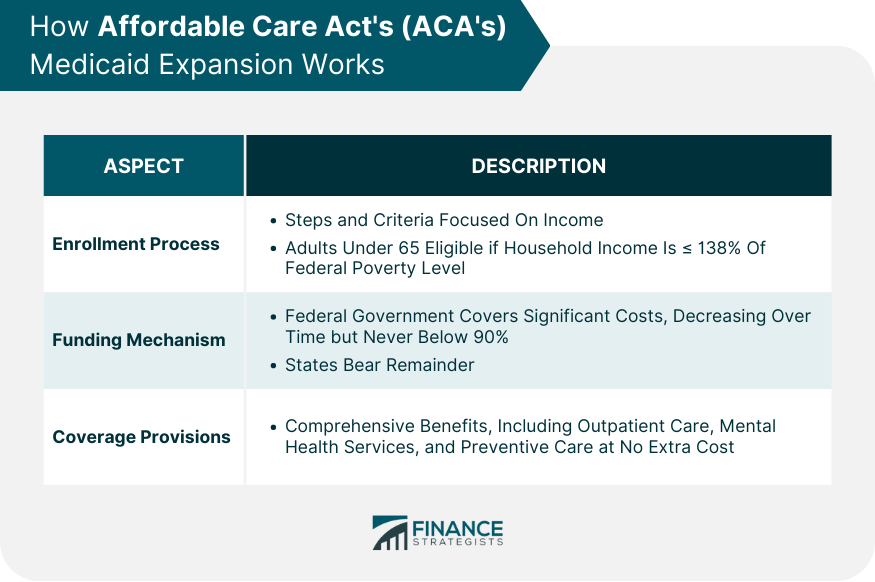
The ACA expanded the eligibility criteria for Medicaid to include individuals and families making up to 138% of the federal poverty level. This change was initially mandatory, but a Supreme Court ruling in 2012 made Medicaid expansion optional for states. Currently, the majority of states have adopted the expansion, which has greatly lowered the uninsured rate among low-income populations.
6. Employer Mandate
An employer with 50 or more full-time employees falls under the large employer category and must furnish a health insurance policy to their employees or be penalized. This provision is aimed at mandating the participation of employers in the health insurance scheme.
7. Preventive Care Requirements
The ACA supports preventive care by requiring insurance companies to offer certain preventive services with no cost-sharing. Such services include counseling, vaccinations, and screenings.

Impact of the Affordable Care Act
The ACA has shaped the U.S. health care system in numerous ways, presenting both opportunities and challenges:
Benefits and Achievements
- Reduced Uninsured Rates: The number of uninsured Americans has significantly decreased since the ACA’s implementation.
- Improved Access to Care: The expansion of healthcare coverage has improved access to critical and preventive services, resulting in enhanced health outcomes.
- Consumer Protections: Policies such as covering pre-existing conditions and the removal of lifetime caps on coverage have strengthened financial and medical security for numerous people.
- Cost Control: While spending on health care services remains high, the ACA has sought to encourage efficiency and control spending through the introduction of value-based care models.
Challenges and Criticism
- Rising Premiums: For some individuals, particularly those who do not qualify for subsidies, critics point to increases in premiums and deductibles.
- Market Instability: Certain areas experienced diminished plan offerings due to market exits driven by insurers’ initial struggles to manage risk pools.
- Political Opposition: Attempts to modify or repeal the ACA have resulted in continuous political friction. This has created uncertainty and hindered comprehensive implementation.
Innovations and Reforms Under The ACA
The ACA enacted several novel reforms designed to enhance the efficacy and quality of health services:
- Accountable Care Organizations (ACOs): These are groups of health care providers that have a shared incentive to provide coordinated care and eliminate wasteful spending.
- Value-Based Payment Models: The ACA discontinued the fee-for-service payment model; henceforth, providers would be compensated based on the value and quality of services rendered.
- Emphasis on Health Information Technology: The promotion of electronic health records and data sharing systems for better care coordination and error reduction is encouraged under the law.
The ACA In The Current Landscape
The ACA continues to be one of the pillars of the United States’ health care system even after more than a decade of its enactment. The fundamental provisions of the law still face legal challenges and political contention, yet they are sustaining attempts to provide comprehensive coverage and transform the health care system.
Recent updates and proposals focus on bolstering the ACA by improving subsidies, closing the Medicaid coverage gap, and tackling health care inequities. The COVID-19 pandemic reinforced the need for affordable and accessible health care, further demonstrating the importance of the ACA.
Conclusion
The Affordable Care Act is perhaps the most important landmark in American healthcare policy to date, seeking to address the triad of access, affordability, and quality.
With all its criticism and challenges, it has been able to bring a remarkable change towards the uninsured population and the consumer protections offered, and its impact cannot be ignored.
In the wake of changes in the healthcare industry, the ACA remains the law of the land for primary restructuring of the healthcare system to enable millions of Americans to access necessary services.
In the foreseeable future, the ACA will continue to transform the healthcare landscape in America by fostering innovations, bridging gaps in health equity, and pursuing universal coverage.
Check the article about the Affordable Care Act
Frequently Asked Questions
1. What is the Affordable Care Act (ACA)?
Answer:
The Affordable Care Act (ACA), also known as Obamacare, is a U.S. healthcare reform law enacted in 2010. Its primary goal is to make health insurance more affordable and accessible, while improving the quality of care and reducing healthcare costs.
2. What are the main goals of the ACA?
Answer:
The ACA aims to:
- Expand access to health insurance
- Protect people with pre-existing conditions
- Improve healthcare quality
- Lower healthcare costs
- Encourage preventive care
3. Who is eligible for ACA coverage?
Answer:
U.S. citizens and legal residents who don’t have access to affordable employer-based coverage and meet income requirements can apply for ACA plans through the Health Insurance Marketplace.
4. What is the Health Insurance Marketplace?
Answer:
The Marketplace (HealthCare.gov or state-run exchanges) is an online platform where individuals and families can compare and buy health insurance plans. It offers standardized plans and determines eligibility for subsidies.
5. What are the metal tiers in ACA plans?
Answer:
ACA plans are divided into four metal tiers based on coverage level:
- Bronze – Lowest monthly cost, highest out-of-pocket costs
- Silver – Moderate balance of premium and coverage
- Gold – Higher monthly cost, lower out-of-pocket expenses
- Platinum – Highest monthly cost, lowest out-of-pocket expenses
6. Can I get financial help under the ACA?
Answer:
Yes, the ACA provides subsidies based on income and household size to help lower monthly premiums and out-of-pocket costs for eligible individuals.
7. What is the individual mandate?
Answer:
Originally, the ACA required most Americans to have health insurance or pay a penalty (the “individual mandate”). However, the federal penalty was eliminated in 2019, though some states still enforce their own mandates.
8. Does the ACA cover pre-existing conditions?
Answer:
Yes, under the ACA, insurance companies cannot deny coverage or charge more for individuals with pre-existing conditions like diabetes, cancer, or asthma.
9. When can I enroll in ACA health insurance?
Answer:
You can enroll during the Open Enrollment Period (typically November to January). If you miss it, you may qualify for a Special Enrollment Period due to life events like losing other coverage, getting married, or having a baby.
10. How has the ACA impacted healthcare in the U.S.?
Answer:
The ACA has significantly reduced the number of uninsured Americans, expanded Medicaid in many states, and introduced essential health benefits requirements, improving access to preventive and comprehensive care.
Pingback: What is Obamacare - JOTmuse
Pingback: What is Marketplace Health Insurance - JOTmuse